Tesla Workers Resist Training Optimus Robots Meant to Replace Them
Tesla's Optimus robot program faces complex hand engineering and worker resistance as the company ends Model S and X production to bet its future on humanoid robotics.
Updated
Why it matters
- Tesla stopped Model S and Model X production at its Fremont factory as of May 2026, reassigning workers and engineers to Optimus.
- Musk called Optimus potentially "the biggest product ever" on Tesla's Q2 2026 earnings call while admitting general-purpose humanoid robots are "one of the hardest things to solve."
- The Information reports complex robot hands and employee pushback against training their robotic replacements are complicating scale-up.
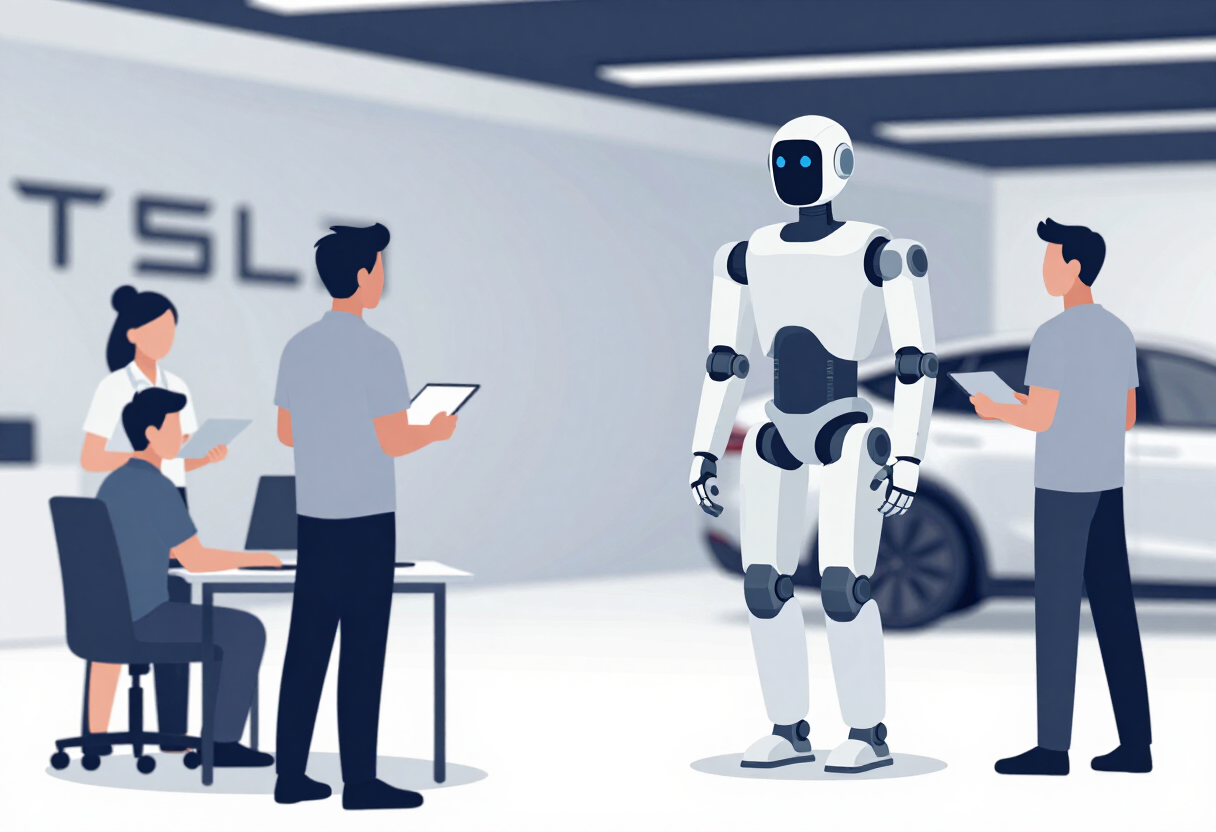
Tesla's shift from electric cars to humanoid robots is running into two stubborn problems: hands that are hard to build and workers who do not want to train the machines sent to replace them.
That is the picture emerging from extensive reporting by The Information, which details multiple complications Tesla faces as it develops its Optimus humanoid robot and attempts to scale toward mass production. The stakes are high. Tesla CEO Elon Musk has explicitly tied the company's future to AI and robotics, and has staked manufacturing capacity on that bet.
Musk has described Optimus as potentially "the biggest product ever" during Tesla's second-quarter 2026 earnings call. But he has also acknowledged the difficulty of the undertaking. Building an autonomous humanoid robot capable of handling many different tasks, he said, is "one of the hardest things to solve." The new reporting suggests Tesla is discovering just how hard.
The challenges cluster around two areas. First, robot hands remain a complex engineering problem — one of the hardest components to get right in general-purpose robotics. Second, employees inside Tesla are pushing back against the task of training the very robots designed to replace their jobs, creating friction on the factory floor as production attempts to scale.
The Fremont, California factory illustrates how far Tesla has already committed to the pivot. As of May 2026, the plant has stopped making the Model S sedan and Model X SUV. Tesla has switched both line workers and engineers from those vehicle programs over to working on Optimus, according to The Information. In other words, the company has already torn out two of its longest-running product lines to make room for robots that have not yet proven they can be manufactured at scale.
The employee resistance factor deserves attention. Humanoid robots of the general-purpose kind that Musk envisions do not learn tasks purely in simulation; they require human demonstration and supervision to acquire the dexterity and task knowledge needed for real-world work. If the humans doing that training see the robots as their own replacements, the quality and pace of that training becomes a labor question as much as a technical one. The Information's reporting indicates this tension is now an active complication inside Tesla's robotics program.
The hand problem is equally concrete. Hands are among the most difficult components in humanoid robotics, requiring the combination of strength, precision, and durability that few suppliers can currently deliver at automotive production volumes. According to The Information, Tesla is contending with supplier and engineering issues as it tries to scale up.
The context matters for anyone tracking the humanoid robotics market. Musk has positioned Tesla not as a carmaker with an AI side project but as a company whose future depends on AI and robotics. That framing helped justify discontinuing the Model S and Model X — vehicles with more than a decade of production history — in favor of a product line that still faces unresolved engineering and supply chain problems.
There is also a credibility question hanging over the program. Musk, as someone who frequently makes claims that fail to materialize, set expectations for Optimus at "the biggest product ever." His own admission that general-purpose humanoid autonomy is "one of the hardest things to solve" sits alongside reporting that the difficulties are not abstract but immediate: component complexity, supplier constraints, and workforce resistance.
The Fremont conversion makes the bet difficult to reverse. With the Model S and Model X lines already shut down and their workers reassigned to Optimus, Tesla has tied manufacturing capacity, engineering headcount, and its stated strategic direction to a robot program that must now overcome both hard technical limits and the reluctance of the people building it. Whether Optimus can move from Musk's earnings-call rhetoric to scalable production will depend on Tesla solving the hand problem, securing its supply chain, and convincing its own workforce to train their successors.
Original: finance.yahoo.com
More from Sophie Lindqvist
Show full bio
Staff writer covering regulation, policy and their impact on artificial intelligence and machine learning at AI In Context.
257 articles
Related articles
- '70% success is like it doesn't work': why AI robots aren't coming to your home
- Toyota to Deploy 400,000 Robots, Spending $6.42 Billion a Year
- Industrial Next promises factory retooling in minutes, with BMW as first test
- Amazon Now Runs Over 1 Million Robots — And 1.5 Million Human Workers
- Destro AI exits stealth with $8M to orchestrate warehouse robots — and the humans beside them